

This Levi's Jean Predates the 501
I spoke with Paul O’Neill, Head of Design for Levi’s Vintage Clothing, to find out what goes into reproducing a 150-year-old pair of jeans (found in a mine!) stitch by stitch.


I’m Emily Stochl and this is Pre-Loved 🎤 the must-read newsletter about the business and culture of vintage and secondhand fashion. If you work in resale, your $5 subscription is likely a business expense.
Hey hi hello! I absolutely love seeing everyone’s vintage Knicks gear surface. Shoutout, also, Hailey Bieber who paired her Knicks tee with 1960s Levi’s Big E denim from LA’s World Vintage. Iconic!
💌 Today’s newsletter includes: Q&A with Levi's Vintage Clothing on the 150-year-old jean found in a mine (which they just reproduced 501 times), the Belgian startup that just won $300K from eBay, Vinted's investment into livestream shopping, why stores are closing their fitting rooms, and the latest in auction house news that includes one of Marie Antoinette’s wardrobe trunks.
→ Follow me on Instagram
→ Follow me on TikTok
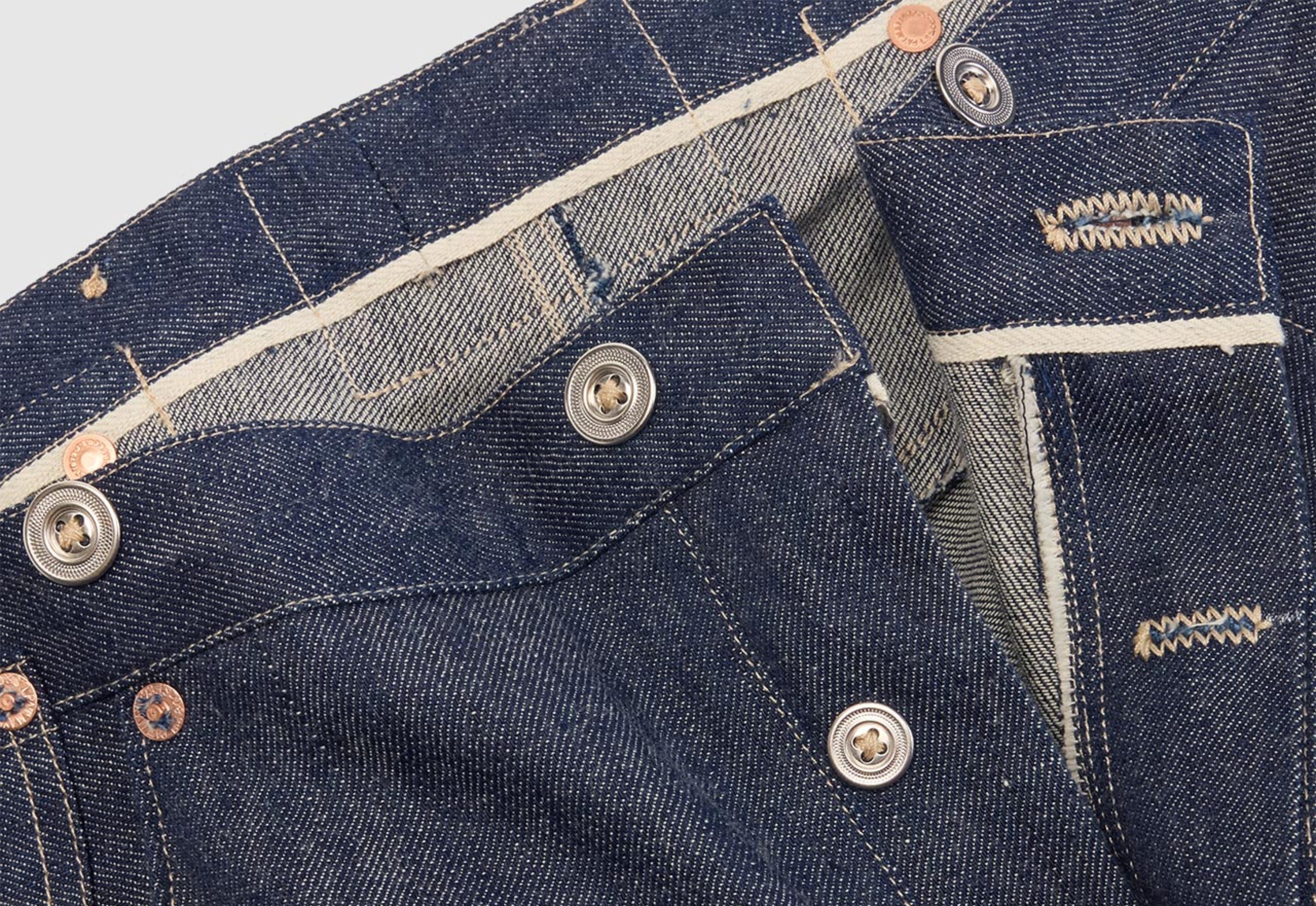
This Levi’s Jean Predates the 501:
Earlier this month, Levi's Vintage Clothing released the “1870s Nevada” jean — a reproduction of one of the earliest “waist overalls” in the company's archive, made from bolts of their own Made in the U.S.A deadstock fabric produced by the now-closed North Carolina mill, Cone Mills.
Levi’s Vintage Clothing is a small sub-brand within Levi’s where designers reproduce some of the company’s historic vintage pieces from the 1870s up through the 1980s — studying them stitch by stitch, recreating the fabrics, hardware, thread colors, and even stitches per inch. Levi’s indeed knows their own vintage well, and they maintain an archive of 20,000 vintage pieces at their San Francisco headquarters. For today’s letter, I called up Paul O’Neill, Head of Design for Levi’s Vintage Clothing, to find out what goes into reproducing a 150-year-old pair of jeans. Below is our conversation.
Can you share the origin story of the Nevada jean, and the vintage piece it's based on?
We have our archive here in San Francisco with over 20,000 pieces dating back to the very beginning of Levi’s in 1873. The Nevada jean is from the first five or six years of production — a very early waist overall, found in a Nevada mining town.
In 1873, Levi’s applied for our patents for producing ‘waist overalls’ with rivets — that was the very first thing we ever made. Then in 1890, we assigned lot number ‘501’ to our waist overalls. In that seventeen-year period before 1890, there was no lot number assigned to our garments; they were simply called ‘waist overalls.’ This jean is from that period.
What’s unique about the Nevada is that it has a tool pocket on the wearer’s left leg — something that was only around for a few years before disappearing entirely. By the time we established the 501 style in 1890, we would never see that tool pocket again. This particular version is the earliest Nevada we have in our archive. We can tell its age because it has hand-sewn buttons rather than shank buttons, and denim pocket bags rather than cotton twill, plus a center-back letter patch — details that date it to a very early waist overall.
How many of these very old pieces do you have in the archive, and do you know anything about where this specific one came from?
We have two or three Nevada jeans in our archive, but this is the earliest. The originals were found in Nevada — that’s how the style became known as the “Nevada,” because these tool-pocket jeans were found in mining areas in the state. We’ve had several pairs in our archives for a long time, but this particular one was only acquired a few years ago, which is why I was so eager to reproduce it.
We do have other waist overalls in our archive — some I can date to pre-March 1871 — but none with the tool pocket. The tool pocket is what defines what we call a “Nevada” jean, and this is definitely the earliest Nevada I’ve seen.
What goes into the vintage reproduction process?
We try to get as close to the original as we possibly can with today’s manufacturing. The reproduction of the Nevada jean was made right here at Levi's headquarters in San Francisco. We produced 501 pairs in our innovation lab using Made in America fabric. Readers may know, we worked with Cone Mills' White Oak plant in North Carolina for over 100 years, and when they closed their mill we acquired as much of our deadstock fabric as we could — including reproductions of fabrics from different eras, right back to the 1870s.
We’ve reproduced earlier Levi’s styles before — the first blue jean from the 1870s and some canvas pieces from 1875 — but this is certainly one of the earliest styles we’ve done. And this was the last of our deadstock 1870s reproduction fabric from Cone Mills, so we decided this was the right project to use it on. This Nevada jean is made in the USA, through and through.
Who is the core customer for Levi's Vintage Clothing?
Our biggest consumer for the line is certainly in Japan — there’s a huge vintage scene there. In Japan we probably have eight different 501 models, from across different eras, always available to buy, whereas in the US there may only be two or three, skewing toward the more commercial-fitting reproduction styles.
Part of the appeal is accessibility. Real vintage Levi’s — especially from the 1930s or the 1950s XX 501s styles (a vintage example sold for $4,600 in April)— have become financially out of reach for most people. Levi’s Vintage Clothing lets them achieve that look at a slightly more affordable price point. [The Nevada jean retailed for $595 — the 501 pairs are sold-out].
Thank you, Paul! To discover more about vintage denim and vintage trends, check out this recent episode of Pre-Loved Podcast with Denim Dudes’, Amy Leverton. 🎧
Solving for Secondhand Fashion’s Sorting Problem:
Earlier this month, I was invited to the eBay Fashion Forum, an afternoon of start-up pitches for eBay’s Circular Fashion Fund Awards, hosted by eBay and Vogue Business. Eight finalists presented their circular start-up proposals, concluding with Trosort, a textile sorting automation company, who was ultimately crowned the winner of the 2026 Circular Fashion Fund, and received a $300,000 investment from eBay Ventures, the venture capital investment arm of eBay. Below is a conversation with the Belgian startup about how they plan to use these funds:
