



I’m Emily Stochl, the secondhand industry’s top resale reporter, and this is Pre-Loved 🎤 the must-read newsletter for vintage dealers, thrifters, collectors, and circular fashion professionals, where we unpack the business and culture of vintage and secondhand.
PS: If you work in resale, your $5 subscription is likely a business expense.
Hey hi hello. I’m back from New Orleans — my first true vacation in years! … The Big Easy delivered! — and back in your inbox. New Pre-Loved Podcast episodes will return next Monday. 🎧
More on New Orleans to come, but I basically spent the week drinking Barq’s rootbeer from a glass bottle and reading by the pool, or getting my 20,000 steps a day checking out the city’s vintage. By the way, I updated Pre-Loved’s Global Directory of Vintage & Secondhand Shops with 20+ spots from NOLA. Bookmark it for your next trip (there or anywhere), as the internet’s largest list of vintage is always growing!
→ Follow me on Instagram
→ Follow me on TikTok
💌 In today’s letter: ThredUp dropped its 14th Annual Resale Report last week, and — like I’ve done for nearly a decade! — I’m breaking it all down for you into key trends and takeaways. Read the full report here.
Key Resale Trends & Takeaways:
The global secondhand market is projected to hit $393 billion by 2030, growing more than twice as fast as overall apparel. In the U.S., resale grew 19% in 2025 alone — nearly four times faster than traditional retail. But “the global secondhand market is no longer just a ‘high-growth story’,” ThredUp co-founder and CEO James Reinhart writes in this year’s Resale Report, “it’s entering a more competitive, structurally complex phase.”
We’ve moved past the era of resale as “trend.” It’s no longer a secondary, “second-best” option — it’s increasingly where consumers start their search.
Pre-Loved readers, you already knew this. You’ve been living it.
Where this year’s findings get interesting are the details — what's shifting underneath the growth story, and what it actually means for resale to be entering a new and "more complex" phase. The report’s release is timely: I've just spent several weeks on my own version of similar research. Pre-Loved's first-ever Secondhand Shopping Survey, published last month, polled nearly 200 active secondhand shoppers — 83% of whom have wardrobes that are majority secondhand, 67% of whom have resold their own clothing. Where ThredUp’s Resale Report charts mass market adoption, my findings dial in on the behavior of super-users who’ve been at this for years.
I’ll be pulling findings from both throughout, plus input from ThredUp’s Senior Vice President of Marketing, Kristen Brophy, who spoke to Pre-Loved last week, prior to the report’s release.
Here's what stood out to me this year. →

The search bar is losing its job.
For the past decade, resale platforms have been built around the assumption that you know what you want to buy, you type it in to a marketplace search bar, and you find it — depending on how hard you were willing to sift through results.
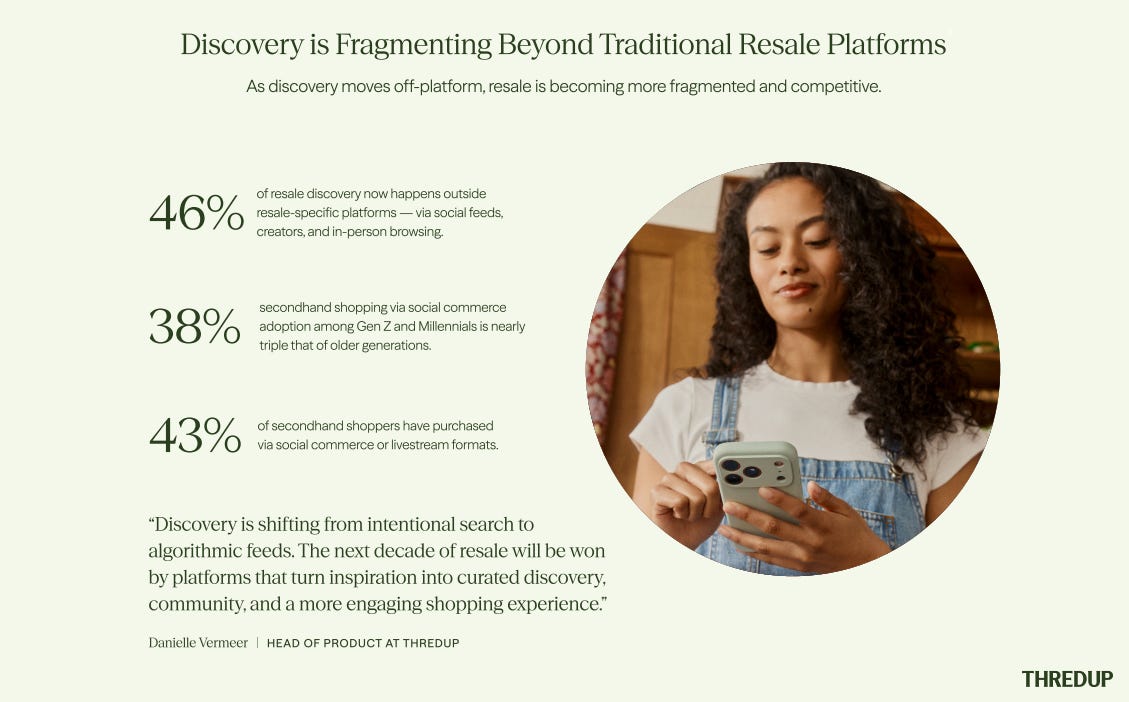
The 2026 Resale Report suggests that assumption is cracking. Nearly half secondhand discovery now happens outside resale marketplaces — through social feeds, creators, livestreams, and in-person browsing. The “want” is being manufactured somewhere else before a shopper ever opens a marketplace, and the search bar is no longer where the journey starts for a growing share of buyers.
“Consumers used to think of resale as a ‘needle-in-a-haystack’ browsing experience,” Brophy told me, “where you wander until you found something. But today it has become incredibly intent-led.”
Social media is now the user’s primary starting place — when a creator shares viral style inspiration, ThredUp sees same-day search spikes, sometimes within minutes. Self-fulfilling that reference loop, their Trend Report tool, launched last year, begins surfaces surging styles to users right as they start to peak.
Quality supply is the industry’s bottleneck.
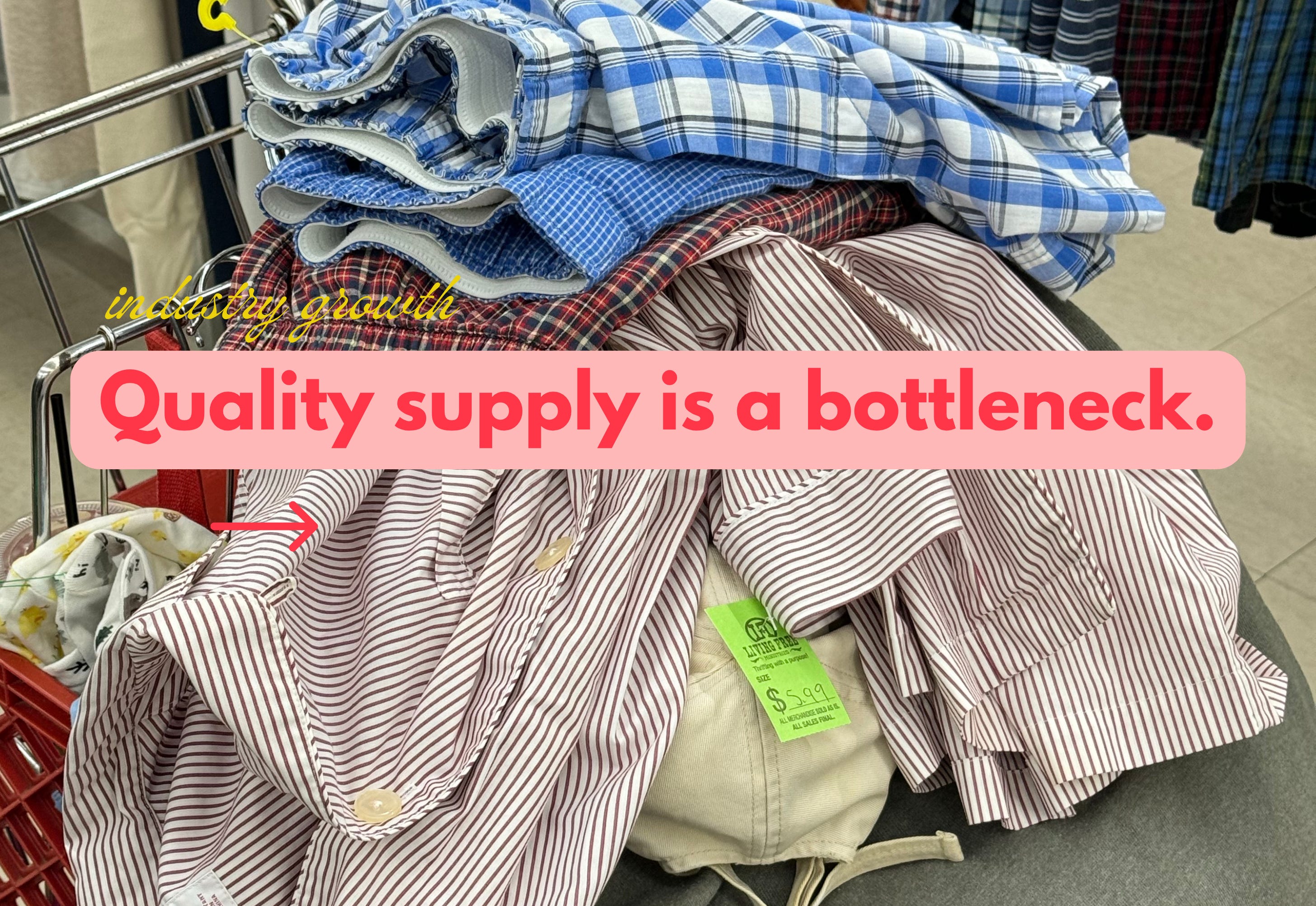
Demand for resale is well-established. Where the constraint on industry growth remains is the sell side: $23.3 billion in U.S. market value will be unlocked by 2030, per ThredUp, by making selling easier. Even among buyers who select “nothing” would motivate them to resell clothing, a third changed their answer when presented with a simpler, more automated listing process.
Brophy says friction on the supply-side falls into two buckets. The first is “mechanical” — things like photography, pricing, shipping logistics — where she believes the industry has made the most real progress. The second is psychological: “it's that internal friction of asking, ‘is selling this actually worth my time?' or 'will I regret letting this go?'" she explains. The unlock, she says, will be removing the mental burden of decision-making to ease resale.
AI is making secondhand shopping easier — but it’s not a silver bullet.
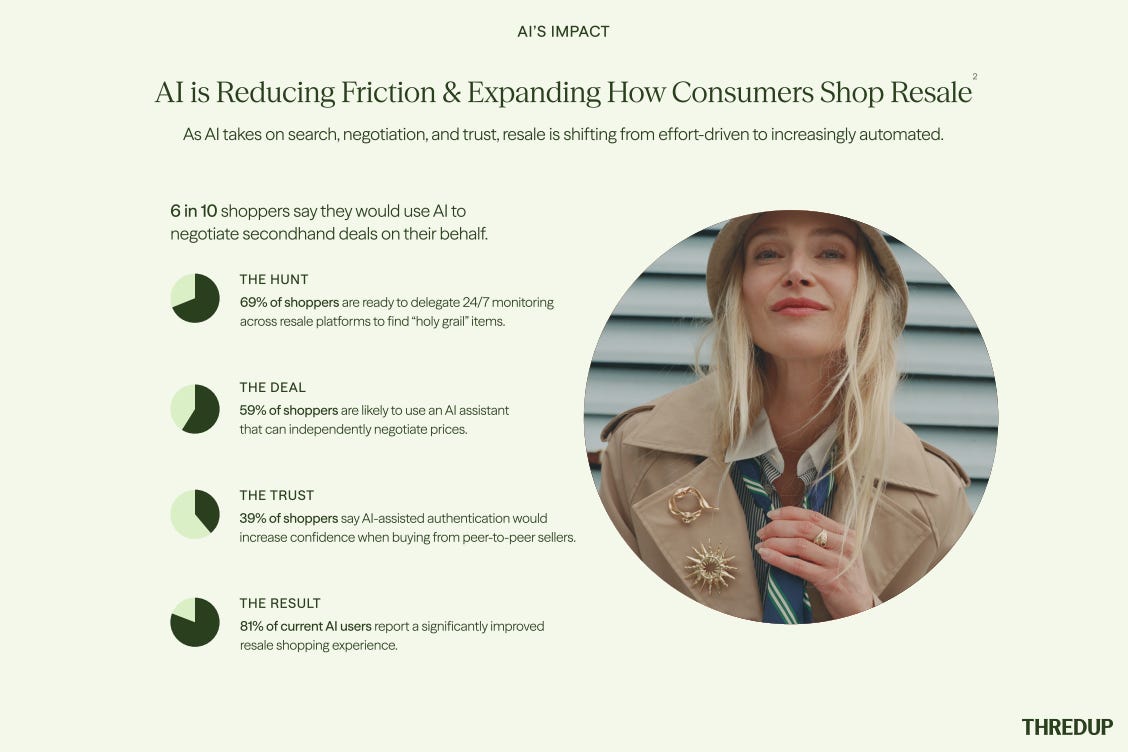
From discovery to pricing to authentication, AI tools are fully incorporated into the secondhand shopping and selling experience, whether users are aware of them or not. 48% of Gen Z already use AI shopping tools and 63% say they’re comfortable with agentic buying. 6 in 10 shoppers of all ages say they’d use AI to negotiate deals on their behalf, and 69% say they’d delegate 24/7 platform monitoring to AI to find them specific items.
For platform operators, the pressure to integrate AI tools that make secondhand shopping and selling meaningfully easier is only going to increase with time.
Yet Pre-Loved's own survey respondents, who have been using secondhand search tools since long before AI entered the conversation, still cite search as a top frustration, with several specifically asking for the ability to filter out low-quality clothing, starting with fast fashion brands. This request points at something bigger. 63% of Pre-Loved’s respondents named “too many low-quality items to search through” as their top frustration in the secondhand market overall. The fast fashion flood, in thrift stores and on resale platforms, is real and ongoing. Worsening even. Surfacing quality — for example, a high-quality sweater buried under thousands of cheaper pieces — is not a problem AI has solved yet. Nor is turning off the faucet of over-produced, low-quality fashion in the first place — going back to the fundamental issue of quality supply.
The market is heavily fragmented, setting the table for consolidation.
Despite its scale, resale is still a long-tail market: thousands of platforms, individual sellers, consignment shops, vintage dealers, thrift store chains, and everything in between. 43% of secondhand shoppers have purchased items via social commerce platforms or livestream formats this year, for example. The Resale Report posits fragmentation sets the stage for increased competition and potential consolidation. The next phase of resale won't be defined by attracting new participants — there are plenty — but by competing for wallet share and supply among the people already here.
For independent sellers, consolidation pressure creates room for differentiated, community-rooted businesses that larger operations can't easily replicate — the vintage dealer who remembers your name, whose specific eye for curation you trust. 77% of Pre-Loved’s survey respondents said they return to sellers they’ve had a good experience with, and 32% have a handful of favorites they buy from repeatedly. In a consolidating market, loyalty like that is not a small thing.
"Holy grail" is replacing the haul.
According to ThredUp, 62% of Gen Z shopped secondhand in 2025, and 67% of them consider the resale value of an item before buying. The report finds they've shifted from high-volume “haul” behavior toward what they dub "holy grail hunting” — fewer purchases, higher intention, and a sharper eye for that ‘one specific item.’
ThredUp's own platform tools back this up. Their Daily Edit — an AI-powered feature that surfaces a personalized selection of 100 items per user per day — has the highest engagement of any feature on the platform. Daily Edit users purchase at more than twice the rate of non-users, with a 23% conversion rate, Brophy told me. “It's shifting the entire conversation from ‘how many things did I get?' to 'did I find the one I've been looking for?'" she said. ThredUp’s search data also reveals more specific search queries and longer session depths where shoppers are hunting for one meaningful item, rather than filling a cart.
Pre-Loved’s survey cohort skewed older — Millennials and Gen X primarily — and they’re several laps ahead of this behavioral shift. Quality and craftsmanship of vintage items was the top motivator for 57% of our respondents. One even described this as “holy grail hunting” before ThredUp even published this framing. Another wrote: “I’m old enough to have the experience of a full trend cycle, decline of item quality, and a solid understanding of my personal style. New retail pieces often feel uninspired, poor quality, or I already own a better example.” These shoppers know what they're looking for, and will wait for it.
Shoppers understand the resale value of their closets.
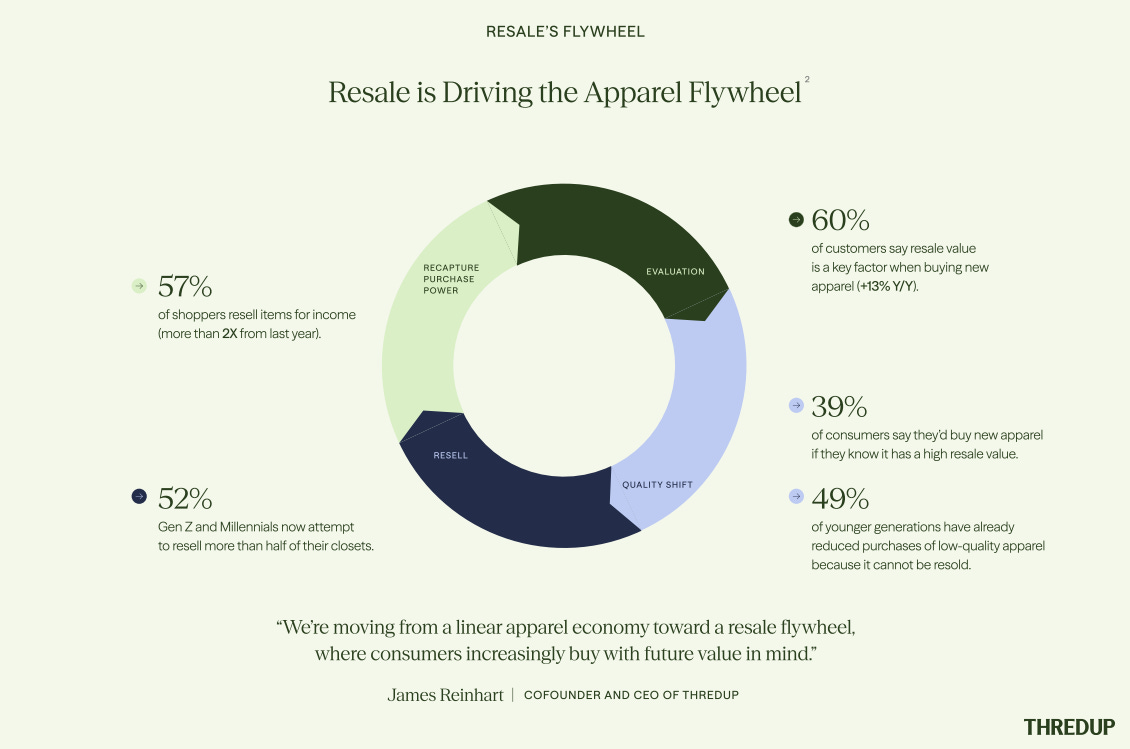
On the selling side, 57% of ThredUp’s sellers say they're reselling for income — more than double last year's figure — and 60% of all consumers now factor “resale value” into their new apparel purchases, up 13 points year-over-year.
This is a genuine shift in how people think about their wardrobes.
“We’re seeing consumers moving away from just looking at the price tag, toward starting to calculate the lifetime value of a garment,” said Brophy.
“It’s made users more savvy and price-elastic, meaning they buy better brands because they know the resale demand for them, and they take better care of their pieces. They’re mentally offsetting the cost of a new purchase with what they expect to get back later.”
She told me ThredUp’s most engaged users are those who both buy and sell — participating in resale’s whole “flywheel.” Clean Out Kit requests from these existing sellers were up 34% year-on-year in 2025, with supply from those users up 14%.
Every year when the ThredUp Resale Report drops, mass-market adoption keeps charting upward, which makes headlines. But in 2026, we’re well past covering secondhand as a trend story — what comes next, after resale’s record growth? What's different about these findings, is the documented shift from “growth” to maturity — from proving that resale works to understanding how it works.
As these trends show, a growing share of people are now participating in the full "buy, wear, resell, reinvest" cycle of circularity — and Brophy says it’s one of the biggest changes of this new era. “The mindset of ‘return on investment’ is a much more durable and sustainable foundation for the industry than bargain hunting and fast fashion trend cycling," she told me. Meaning a more evolved resale industry isn't just bigger than it was. It's built on something that might actually hold.
As resale matures, growth figures will keep making headlines. But what happens within its culture is the more interesting question. That's the one I'll be chasing.
🗞 Read this next:
Pre-Loved is “save for later” friendly. Here’s what subscribers enjoyed this month:


Thanks for reading Pre-Loved! You can find me across the internet on Instagram, TikTok, and LinkedIn! 💛 - Emily
Such great takeaways here Emily! Appreciate your expert perspective on this report.